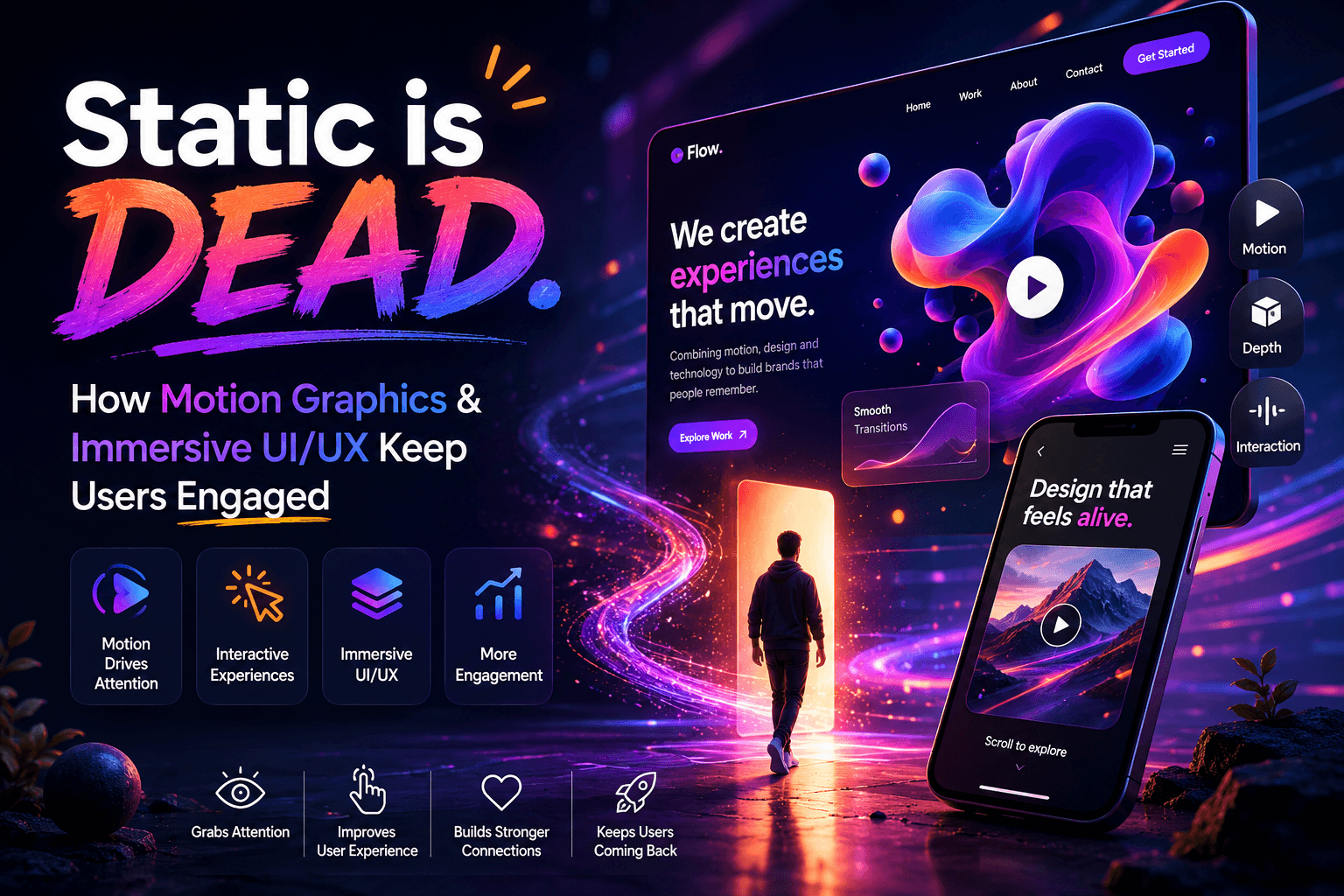
The internet has changed
People don’t experience content the same way anymore.
A few years ago, static websites and simple visuals were enough to grab attention. Today, users scroll faster, attention spans are shorter, and competition is everywhere.
If something feels flat, slow, or lifeless, people leave within seconds.
That’s why modern brands are moving toward motion-driven experiences and immersive UI/UX design.
Because static design alone is no longer enough to keep users engaged.
Attention is the new currency
Every app, website, and brand is fighting for attention.
And honestly, users have become harder to impress.
People now expect:
Smooth animations
Interactive interfaces
Micro-interactions
Dynamic scrolling
Cinematic visuals
Fast and immersive experiences
When a product feels alive, users naturally spend more time exploring it.
That emotional engagement matters more than most businesses realize.
Motion graphics are no longer “extra”
A lot of brands still treat motion graphics like an optional design feature.
But today, motion is part of communication itself.
Good motion design helps users:
Understand interfaces faster
Focus on important actions
Feel smoother navigation
Stay emotionally connected
Experience stronger storytelling
Even small animations can completely change how premium a product feels.
That’s why the world’s biggest tech brands invest heavily in motion design.
Because movement creates emotion.
Why static design feels outdated now
Static layouts often feel disconnected from modern user behavior.
Users are used to highly interactive platforms like:
Instagram
TikTok
Apple websites
Modern SaaS products
Gaming interfaces
Compared to those experiences, plain static websites feel old almost instantly.
It’s not because static design is “bad.”
It’s because user expectations evolved.
People now expect experiences, not just pages.
Immersive UI/UX changes how people feel
Good UI/UX is no longer just about usability.
It’s about creating emotional interaction.
Modern immersive experiences use:
Smooth transitions
Scroll-based animations
Interactive 3D elements
Motion feedback
Dynamic typography
Layered visual depth
These elements make interfaces feel responsive and alive.
When users enjoy interacting with a product, engagement naturally increases.
Small animations create huge impact
Not every interaction needs dramatic motion.
Sometimes the smallest details matter most.
A button reacting smoothly.
A hover animation.
A subtle page transition.
A loading interaction that feels satisfying.
These tiny moments make digital products feel polished.
Users may not consciously notice them, but they definitely feel the difference.
That’s what separates average digital experiences from memorable ones.
Motion helps storytelling
Motion graphics are powerful because they guide attention naturally.
Instead of forcing users to read everything, movement directs the eye smoothly across the experience.
That’s why motion works so well for:
Brand storytelling
Product launches
Landing pages
Explainer content
Portfolio websites
App onboarding
Good motion makes information easier to absorb while keeping users visually engaged.
The psychology behind interactive design
Humans naturally respond to movement.
Our brains are wired to notice motion faster than static visuals.
That’s why animated interfaces often feel more exciting and intuitive.
Interactive design creates curiosity.
Curiosity keeps users exploring.
And longer engagement usually leads to stronger brand connection and better conversion rates.
But motion should never feel overwhelming
One of the biggest mistakes designers make is adding motion everywhere without purpose.
Too much animation becomes distracting.
The best motion design feels natural.
It supports the experience instead of stealing attention from it.
Good immersive UI/UX is not about making everything move.
It’s about making interactions feel meaningful.
Why modern brands are investing heavily in immersive experiences
Today, brands are competing through experience more than ever before.
Products with strong motion and immersive UI/UX often feel:
More premium
More modern
More innovative
More trustworthy
That perception directly affects how users interact with a brand.
Especially in crowded industries where attention disappears quickly.
The future of digital design is interactive
Websites are slowly becoming digital experiences instead of simple information pages.
The line between design, storytelling, and interaction is getting smaller every year.
Brands that still rely only on static visuals risk feeling outdated very quickly.
Because modern users don’t just want to see content anymore.
They want to experience it.
Final thoughts
Static design isn’t completely dead.
But static-only experiences are becoming easier to ignore.
Motion graphics and immersive UI/UX help digital products feel alive, engaging, and emotionally memorable.
Not through flashy effects alone.
But through thoughtful interactions that make users feel connected to the experience.
Because in today’s digital world, attention lasts only a few seconds.
And the brands that create movement, emotion, and interaction are the ones people remember.